
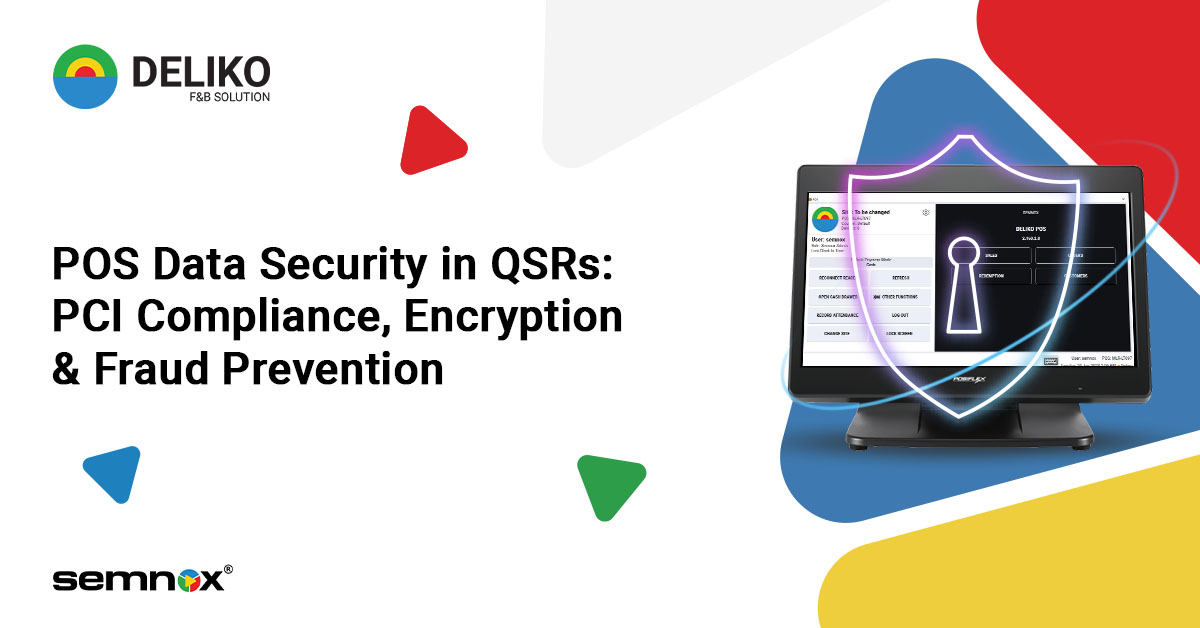
POS Data Security for QSRs: PCI Compliance, Encryption & Fraud Prevention
Imagine a bustling QSR during the lunch rush, orders flying in, cards swiping, and screens flashing with payments every few seconds. Amid all this speed and precision, one invisible ingredient keeps everything running smoothly: security.
POS data security for QSRs isn’t just a back-end concern; it’s the backbone of customer trust. With self-order kiosks, contactless payments, and online integrations becoming the norm, even a single data breach can halt the momentum, shatter brand credibility, and drain profits overnight.
The recipe for protection? A smart blend of PCI compliance, advanced encryption, and fraud prevention strategies that ensure your QSR serves not only great food, but also confidence with every transaction.
Let’s dive deeper into POS data security in QSRs, explore effective ways to prevent fraud, and discover the best practices every QSR should follow to keep data safe and build lasting customer trust.
Start now!
Understanding POS Data Security in QSRs
At its core, POS data security for QSRs refers to the protection of customer payment information and transaction data processed through Point-of-Sale systems. From credit card swipes to mobile wallet transactions, every piece of data must remain confidential, encrypted, and compliant with industry standards.
Today’s modern QSR POS systems aren’t just billing tools; they are data hubs that integrate with online ordering systems, loyalty programs, and inventory management systems. This makes them prime targets for cybercriminals. Investing in secure restaurant billing software with advanced authentication, tokenization, and real-time monitoring is no longer optional; it’s essential.
The Cost of Ignoring POS Security
A data breach doesn’t just hurt your system; it can break your brand. QSRs that neglect POS fraud prevention strategies risk losing customer data, facing legal penalties, and enduring long-term damage to their reputation. Even a small restaurant can face tens of thousands of dollars in losses from a single attack.
In addition, recovering from a breach can take months; often longer than it takes to implement proper preventive measures. Simply put, ignoring POS security costs far more than maintaining it.
PCI Compliance: The Foundation of Secure Transactions
When it comes to PCI compliance for restaurants, adherence to the Payment Card Industry Data Security Standard (PCI DSS) is non-negotiable. This global standard ensures that every card transaction is protected through robust data handling, storage, and transmission practices.
Maintaining PCI compliance means your restaurant is following key security measures such as using firewalls, encrypting sensitive data, and regularly testing security systems. It’s not just about meeting requirements; it’s about building customer trust every time they tap or swipe their card.
Fraud Prevention: Beyond Basic Passwords
Cyber threats today are far more sophisticated than they were a few years ago. Relying on passwords alone is like locking your door but leaving the window open. Modern POS fraud prevention strategies go beyond the basics.
This includes implementing multi-factor authentication (MFA), using AI-powered fraud detection tools, and setting up transaction alerts. Real-time analytics can help detect suspicious behaviour instantly, such as unusual transaction volumes or repeated card declines, thereby preventing fraud before it occurs.
Cloud vs On-Premise Security: Which is Safer for QSRs?
Both cloud-based and on-premise POS systems offer unique benefits, but when it comes to QSR POS encryption, the cloud often takes the lead. Cloud-based POS solutions for food courts and restaurants offer automatic updates, centralized data security, and scalable encryption models; all managed by dedicated experts.
On-premise systems, while giving you full control, require regular maintenance, manual updates, and in-house IT support. For multi-outlet QSR chains, the cloud provides a more efficient and safer solution to maintain consistent security standards across all locations.
Here, a comparison table will provide more clarity to you:
|
Feature |
Cloud-Based POS Systems |
On-Premise POS Systems |
|
Data Security |
Managed by expert providers with advanced QSR POS encryption and real-time monitoring. |
Security depends on the internal IT team and manual oversight. |
|
Updates & Maintenance |
Automatic software updates and security patches ensure continuous protection. |
Requires manual updates and frequent maintenance checks. |
|
Scalability |
Easily scalable across multiple outlets or POS solutions for food courts. |
Scaling requires new hardware installations and local configurations. |
|
Data Backup & Recovery |
Automated cloud backups reduce the risk of data loss. |
Requires manual updates and frequent maintenance checks. |
|
Cost Efficiency |
Lower upfront costs and predictable subscription pricing. |
Higher upfront investment in hardware and IT infrastructure. |
|
Accessibility |
Secure access from any location via the internet. |
Limited to physical system access at each outlet. |
|
Support & Monitoring |
24/7 support and centralized monitoring by cloud service providers. |
In-house IT support is required for troubleshooting and monitoring. |
Also Read: On-Premise vs Cloud POS for Restaurants: Which is Right for You?
Best Practices Every QSR Should Follow Today
To strengthen POS data security for QSRs, here are some proven best practices:
- Use end-to-end encryption (E2EE) to protect customer data throughout the transaction journey.
- Regularly update POS software and apply security patches immediately.
- Limit access to POS systems based on user roles and job responsibilities.
- Conduct frequent PCI compliance audits to stay ahead of vulnerabilities.
- Train employees on recognizing phishing attempts and suspicious activities.
- Back up data securely to recover quickly in case of system compromise.
Consistency in applying these measures ensures long-term protection and smooth business operations.
Related Blog: Best Practices for Data Protection in QSR POS Systems.
Conclusion: Security is the New Ingredient of Customer Trust
In the digital dining era, POS data security for QSRs isn’t just a technical necessity; it’s a customer promise. Every tap, swipe, or scan represents trust, and protecting that trust defines a brand’s success.
That’s where Deliko steps in as the smarter choice. Designed with QSR POS encryption, advanced fraud prevention mechanisms, and built-in PCI compliance for restaurants, Deliko ensures that every transaction is fast, safe, and seamless.
Its secure restaurant billing software offers centralized monitoring, AI-based threat detection, and cloud-driven scalability, making it ideal for both single outlets and large POS solutions for food courts.
With Deliko, you don’t just process payments; you protect experiences. Because in today’s QSR world, security isn’t an add-on; it’s the secret ingredient of trust.
Ready to Secure Every Swipe?
Protect your QSR from data breaches, fraud, and downtime with Deliko’s all-in-one secure POS solution. Experience seamless transactions, advanced encryption, and complete PCI compliance, all designed for the speed and scale of quick-service dining.
Book a Free Demo with Deliko Today, and make every transaction a secure one!
Frequently Asked Questions (FAQs)
1. What does POS data security for QSRs mean?
POS data security for QSRs refers to the systems and practices that protect customer payment information processed through Point-of-Sale terminals. It includes encryption, tokenization, and adherence to PCI DSS standards to prevent data breaches and fraud.
2. Why is PCI compliance important for POS data security in QSRs?
PCI compliance ensures that your restaurant follows strict data protection protocols when handling cardholder information. This minimizes the risk of hacking, strengthens customer trust, and helps avoid costly penalties for non-compliance.
3. What are the best practices for maintaining POS security in QSRs?
To maintain strong POS data security for QSRs, it’s crucial to use end-to-end encryption, enable two-factor authentication, and regularly update POS software to patch vulnerabilities. Restrict user access based on roles, use secure Wi-Fi networks, and conduct frequent security audits to detect potential threats early.
4. How often should a QSR review its POS security system?
A QSR should review its POS security system at least every 6 months or whenever a system update, hardware change, or new payment integration occurs. Regular vulnerability assessments and PCI compliance checks help ensure ongoing protection against emerging cyber threats.
5. What happens if a QSR fails to maintain POS security?
If a QSR fails to maintain POS data security, it risks data breaches, financial losses, legal penalties, and reputational damage. Non-compliance with PCI standards can lead to hefty fines and loss of customer trust, ultimately affecting the restaurant’s long-term profitability and brand image.

As a highly experienced thought leader in the hospitality industry, Suresh Kumar carries a unique combination of global experience and multi-industry specialty. With 15 years of experience as the marketing head and director of Lucid IT Solutions and seven years of directing sales at Pazo, Suresh has especially honed skills with F&B and restaurant POS — skills that make him an irreplaceable asset at Semnox. Now, he spearheads the realm of cafeteria management solutions through seamless business operations and collaborative development.